

- New Roots
Hair Transplant Process: Step-by-Step Complete Guide
Table of Contents
Hair loss affects millions of men and women worldwide, and it often hits confidence and self-image pretty hard. Still, there’s good news because today’s hair restoration techniques can be permanent, and they can look natural too.
But before someone goes in for the procedure, a lot of patients want to figure out how the hair transplant process really works,like from consultation to final outcomes, what should they actually expect ,step by step.
In Bangladesh, hair transplant procedures have been growing in popularity, mainly because medical technology has improved, surgeons are more experienced, and people are simply more aware of hair restoration options.
When you understand the entire process, patients can prepare better and also keep expectations in a realistic lane, not too high, not too low.
So, this guide walks through the whole journey—starting with the consultation, then the surgery itself, followed by recovery, and finally the long-term results that come afterward.
What Is a Hair Transplant?
A hair transplant is basically a surgical procedure where healthy hair follicles get moved from a donor area, usually the back, or the sides of the scalp into spots where thinning happens or where baldness shows up.
The transferred follicles keep growing as usual in their new placement because they still have their genetic resistance to hair loss, which is kind of the key part.
Today’s approaches are mainly:
- Follicular Unit Extraction (FUE)
- Follicular Unit Transplantation (FUT)
Both methods follow a kind of similar overall hair transplant process, even if the harvesting technique differs a little, kinda.
Understanding the Hair Transplant Consultation Process
The first stage of the hair transplant consultation process is one of the most important parts of the journey. During consultation the surgeon evaluates:
- Hair loss pattern
- Scalp condition
- Donor hair quality
- Family history of hair loss
- Medical history
- Future hair loss risk
The consultation also sort of helps figure out, if the patient is a suitable candidate for transplantation or not, in general.
Topics commonly discussed include:
- Expected results
- Required graft numbers
- Procedure type
- Recovery timeline
- Cost estimates
- Long-term maintenance
A thorough consultation sort of sets up the base for a successful treatment plan, honestly it kind of forms the foundation that you’ll later rely on.
Pre and Post Hair Transplant Care: Preparing for Surgery
Proper preparation really helps a lot toward successful outcomes, although it can feel kinda vague at first. If people understand both pre and post hair transplant care, they can reduce complications easier, and also help healing along more efficiently.
In other words, getting ready beforehand and then following aftercare guidance makes a noticeable difference.
Before the Procedure
Patients are typically advised to:
- Avoid smoking for several days before surgery
- Reduce alcohol consumption
- Inform the surgeon about medications
- Follow pre-operative instructions carefully
- Wash the scalp thoroughly before treatment
Some medicinals might need a temporary tweak, depending on the clinicians guidance , yes.
Good prep work helps set up favorable surroundings for the graft to remain alive and well.
Hair Transplant Step by Step: The Complete Procedure
Lots of people, who come in as patients, want this detailed explanation about the hair transplant step by step, kind of journey. In most cases the whole procedure will follow a few key stages, and it usually moves along in a certain order, even if the exact timing might vary a little
Step 1: Arrival and Pre-Operative Assessment
On surgery day, the medical team does a quick review of the treatment plan and confirms the target areas. They check everything, just before starting, so the plan lines up with the precise spots.
The surgeon may:
- Examine the scalp again
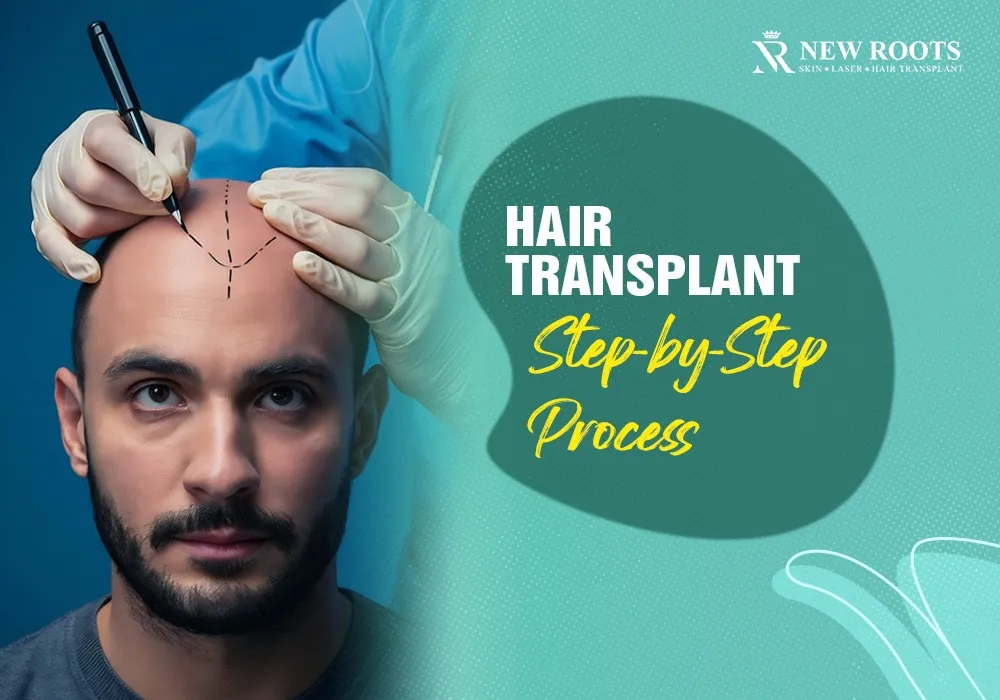
- Mark the hairline
- Review graft estimates
- Take pre-operative photographs
This makes sure that both the patient, and the surgeon have clear expectations before treatment starts , like everything is kind of aligned upfront.
Step 2: Hairline Design
Hairline design is, like, one of the most crucial aspects of the hair transplant process. It matters a lot to have a clean and natural-looking front line, even if everything else is good. When the framing feels right , the whole result looks more believable and intentional, not just random.
The surgeon creates a customized hairline based on:
- Facial proportions
- Age
- Existing hair pattern
- Future hair loss considerations
A natural-looking hairline significantly affects the final cosmetic result.
Step 3: Administration of Local Anesthesia
One of the most common worries that patients have is about anesthesia in hair transplant procedures , honestly, it comes up a lot. Usually , these hair transplants are done using local anesthesia, and that part is pretty standard across many clinics.
The anesthetic numbs both:
- Donor area
- Recipient area
Patients remain awake throughout the procedure but experience minimal discomfort.
Additional comfort measures may be used if necessary.
Once anesthesia takes effect, the surgery can begin.
FUE Hair Transplant Steps
Most recent procedures in Bangladesh kinda stick with the FUE technique for hair, or at least that’s what you’ll see most often. With FUE, the hair transplant steps basically include taking individual follicular units straight out of the donor area directly, one by one.
Donor Area Preparation
The donor region is trimmed and prepared for extraction.
The surgeon identifies healthy follicles suitable for transplantation.
Follicular Unit Extraction
With specialized micro-punch instruments, single follicular units are carefully extracted kinda, bit like—one by one, in a quiet procedure, while removing them.
Each graft may contain:
- One hair
- Two hairs
- Three hairs
- Four hairs
The surgeon extracts grafts while preserving donor area appearance.
This stage may take several hours depending on the number of grafts required.
FUT vs FUE Procedure: Key Differences
When patients are trying to understand the FUT vs FUE procedure comparison, it can really help them pick which option fits best. It’s kind of like a simple decision path… FUT vs FUE, and then the whole “which one is right for me” question, you know?
FUT Procedure
FUT involves:
- Removing a strip of scalp tissue
- Separating follicular units under microscopes
- Closing the donor area with sutures
Advantages:
- Higher graft yield in some cases
- Efficient for extensive hair loss
Disadvantages:
- Linear scar
- Longer recovery
FUE Procedure
FUE involves:
- Individual graft extraction
- Minimal scarring
- Faster healing
Advantages:
- Less visible scarring
- Quicker recovery
- Popular among modern patients
Disadvantages:
- Longer extraction time
- Potentially higher cost
Both methods can produce pretty excellent results, if done properly. At least I have seen it, and sometimes it feels like the difference is small but still real
Graft Extraction and Implantation
One of the most important phases of the surgical procedure involves graft extraction, and then implantation, kind of right away.
Graft Preparation
After extraction, follicles are carefully sorted and preserved.
The medical team evaluates:
- Graft quality
- Hair count per follicle
- Viability
Proper graft handling is essential for successful growth.
Recipient Site Creation
The surgeon creates tiny channels in the recipient area.
Each incision is designed according to:
- Hair angle
- Growth direction
- Desired density
At this stage it kinda decides how “natural” the end result looks, you know, like how it appears overall.
Implantation Phase
The grafts are then placed into the prepared sites.
The surgeon strategically positions follicles to create:
- Natural density
- Proper hairline transitions
- Realistic growth patterns
This part needs a lot of precision , plus some artistic planning too, in a kind of very deliberate way.
Hair Transplant Surgery Duration
Many patients ask about hair transplant surgery duration before scheduling treatment.
The length of the procedure depends on:
- Number of grafts
- Procedure type
- Complexity of restoration
Typical timelines include:
- Small sessions: 4–6 hours
- Moderate sessions: 6–8 hours
- Large sessions: 8–12 hours
Some extensive procedures may be divided across multiple days.
Patients can generally take short breaks during the surgery.
Immediately After the Procedure
Once surgery is complete:
- The scalp is cleaned
- Post-operative instructions are provided
- Medications may be prescribed
- Follow-up appointments are scheduled
Mild redness and swelling are normal during the first few days.
Most patients return home on the same day.
Recovery After Hair Transplant
Getting a grasp on recovery after a hair transplant kinda helps patients get ready for the whole healing journey and also keep expectations grounded.
The thing is, recovery usually happens slowly over multiple months, as those transplanted follicles settle in and start producing new hair.
In the first week, mild swelling, redness, little scabs , and some mild irritation are pretty normal. It’s best not to touch the grafts , not do strenuous workouts, and avoid stuff that ramps up sweating too much, because careful aftercare really supports graft survival and overall success.
Between weeks two and four, the scabs are typically gone. A lot of people notice a temporary shed of the transplanted hairs, sometimes called shock loss. That part is normal , and the follicles are still healthy under the scalp even if it looks like things are falling out.
From around month two through month four, new growth starts showing up. At first the hair can look wispy or thin , yet over time the density ramps up gradually.
Then by months six to nine, you can usually see better coverage, improved hairline shape, and a more noticeable thickness. Most patients end up seeing their final results roughly at twelve to eighteen months after the procedure.
Hair Transplant Healing Stages
Hair transplant recovery stages happen kind of slowly, over a few months, and when patients get the idea of each part, it’s easier to keep those expectations…more realistic during the whole healing time.
Stage 1: Right after surgery recovery
The very first recovery stage starts right after the procedure, and it usually covers the first several days. In this window, mild redness, puffy swelling, and little crusts can show up around the transplanted grafts.
These things are pretty normal in the healing rhythm and they tend to calm down fast when patients follow good aftercare, plus any prescribed meds
Stage 2: Shedding time
Between about week two and week six, a lot of the transplanted hairs begin to shed. This pause in growth is temporary, and it’s normal, so it really shouldn’t be taken as transplant failure. Under the surface, the hair roots are still healthy, they stay in place and they ready themselves for the next growing phase.
Stage 3: Early Growth
Around the second to fourth month, new hairs start coming out of the transplanted follicles. At first, it can look kinda thin and not perfectly even, but over time density tends to pick up, once the follicles become more active, and you notice that change little by little.
Stage 4: Maturation
From about six to eighteen months after the surgery, the transplanted hair keeps developing and settling in.
The hair usually turns thicker, feels stronger , and looks more natural. For most people, this is when the “final” look starts showing up, meaning better density, improved texture, and wider overall scalp coverage.
Knowing these healing phases can make it easier to stay patient during recovery and not panic over small variations while waiting for full results.
Pre and Post Hair Transplant Care Tips
Going by the right pre and post hair transplant care recommendations can make the results better, and sort of improve the outcome overall.
Post-Procedure Care
Patients should:
- Follow washing instructions carefully
- Sleep with the head elevated initially
- Avoid scratching the scalp
- Take medications as prescribed
- Attend follow-up appointments
Lifestyle Considerations
For optimal results:
- Maintain a healthy diet
- Stay hydrated
- Avoid smoking
- Manage stress levels
Good scalp health supports stronger hair growth.
Hair Transplant Process in Bangladesh
Bangladesh has seen rather notable growth with hair restoration services over the last few years, and lately it feels like clinics are doing more and more.
A lot of modern places are rolling out advanced FUE approaches, better machinery, and a more personal, tailored treatment mapping.
Still, if someone is thinking about going there for a procedure, it helps to prioritize a few things first:
- Qualified surgeons
- Proven results
- Transparent consultations
- Proper aftercare support
Picking a trustworthy clinic can really help with the whole transplant journey and the long haul result. It might sound small but it’s not just about the medical process , it’s also the way the team handles things day to day.
Conclusion
Getting the full picture of the hair transplant process helps patients walk into treatment with confidence ,and with a real sense of what to expect.
During the hair transplant consultation process, anesthesia in hair transplant procedures, all the way through graft extraction and graft implantation, each step matters a lot. It’s kind of a chain, you skip one part and the rest can feel weird, not as smooth.
Whether you’re weighing a FUT vs FUE approach, or you’re trying to understand recovery after hair transplant, having the right know-how makes it easier to decide.
Also, when patients follow the suggested pre and post hair transplant care guidelines and partner with a skilled surgeon, they can support better graft survival. In the end, it often means lasting improvements in their look and, honestly, more self-assurance too.
Frequently Asked Questions (FAQs)
Usually this process goes something like consultation, hairline mapping , then local anesthesia , after that donor hair extraction and maybe recipient site creation. Next comes graft placement , plus post operative care then it just continues through recovery for a few months, you know over time.
Typically it runs somewhere from 4 to 12 hours, depending on how many grafts you need and how complicated the case is. Sometimes more grafts means longer time, sometimes the technique makes the day feel different.
Most people report minimal discomfort, because local anesthesia is used throughout the procedure. During recovery, you might feel mild soreness or a bit of tightness, but usually it’s manageable with the provided meds.
Healthy follicles are extracted from the donor zone, then the surgeon creates recipient sites, and afterward the grafts are carefully implanted into thinning or bald regions so hair growth can be restored in those areas. It’s pretty methodical, like careful placement, not just “drop in and done.”
Initial healing often happens within one to two weeks. New hair growth commonly starts after a few months, and the final visible results usually show up between 12 and 18 months after surgery.
Archives
- August 2026 (1)
- July 2026 (8)
- June 2026 (7)
- May 2026 (10)
- March 2023 (1)
- November 2022 (1)
- October 2022 (2)
- August 2022 (3)
- July 2022 (4)