


- New Roots
Hair Transplant Density: How Many Grafts Do You Really Need?
Table of Contents
Hair loss can really hit confidence, the way you look, and even self-esteem, so it’s pretty normal that many people start thinking about hair transplantation as a long-term fix.
Still, one of the most common things patients ask before treatment is, “How many grafts do I actually need?” The honest answer depends a lot on hair transplant density, because that part is what decides how full and natural the final results will look.
In Bangladesh , interest in hair restoration procedures has grown a lot , as more individuals look for workable solutions for thinning hair and baldness.
If you understand hair transplant density, you can plan better, like what graft count to expect, what the results might look like, and what your overall outcome could feel like.
In this guide, we break down how density is measured, how many grafts might be needed for different levels of hair loss, and which factors influence that fullness effect after a transplant .
What Is Hair Transplant Density?
Hair transplant density is about the amount of grafts, or really follicular units, placed into a given zone on your scalp.
People usually count it as grafts per square centimeter, and this then pretty much helps predict how thick , and more or less natural, the transplanted hair will look once it’s settled.
Density is also one of the most important things in hair restoration, because covering a bald patch, on its own, usually won’t be enough.
What matters is achieving that natural looking outcome, where the new growth blends in with the surrounding hair like it was always there.
There are several pieces that affect how density is planned, like the following :
- Size of the bald area
- Quality of donor hair
- Hair thickness
- Hair color
- Hair texture
- Desired cosmetic outcome
A carefully planned density strategy can significantly improve the final appearance of the transplant.
Understanding Natural Hair Density
To get what transplant density really means, it helps to start with natural hair density first, kinda like a baseline.
A healthy scalp usually holds somewhere in the range of 80 to 120 follicular units per square centimeter, though it does shift a lot from person to person.
Things like genetics, ethnicity, age, and even how the hair behaves or feels, all affect natural density in their own way.
Most hair transplant approaches don’t really try to mirror the exact density someone had back in adolescence. Instead, surgeons tend to concentrate on the visual sense of fullness, while also using donor hair in a more efficient, careful manner.
Since donor follicles are finite, the overall look of natural density is often more valuable than hitting the original follicle number exactly.
Hair Graft Density Per cm2 Explained
One of the most frequently discussed concepts in hair restoration is hair graft density per cm2.
Different density levels typically provide different cosmetic outcomes:
- 20–30 grafts/cm² – Basic coverage
- 30–40 grafts/cm² – Moderate density
- 40–50 grafts/cm² – Strong cosmetic density
- 50–60 grafts/cm² – High-density appearance
The “ideal density” kinda depends on the patient’s hair characteristics and the treatment goals, not just one number. For instance, people with thick or curly hair may need fewer grafts, to reach the same visual fullness, compared with someone who has fine straight hair.
Density vs Grafts Hair Transplant: Understanding the Difference
A lot of patients zero in on the simple total number of grafts that a clinic quotes. But honestly, understanding density vs grafts in hair transplant planning is kinda essential, not optional.
Grafts basically means the total number of follicular units that are moved and transplanted. It’s just the overall count.
Density is more like how tightly those grafts are positioned within a given patch or region, so it is about spacing in that same area.
For example:
- 3,000 grafts spread over a bigger bald zone might still end up looking like moderate coverage.
- Yet those same 3,000 grafts, if they are concentrated into a smaller area, can create a much higher density and it can show up more intensely, visually speaking.
So in many cases, density ends up mattering more for the final look than graft count alone.
Factors That Determine How Many Grafts You Need
Size of the Recipient Area
The larger the bald or thinning area, the more grafts are required to achieve adequate coverage.
Typical graft estimates include:
- Hairline restoration: 800–1,500 grafts
- Frontal region: 1,500–2,500 grafts
- Crown area: 1,000–2,500 grafts
- Advanced hair loss: 3,500–6,000+ grafts
Hair Characteristics
Hair texture and thickness strongly influence perceived density.
Patients with:
- Thick hair
- Curly hair
- Dark hair
- Multi-hair grafts
often achieve better visual density with fewer grafts.
Desired Density
Some patients prioritize broad coverage, while others want maximum fullness in specific areas. Higher density goals naturally require more grafts.
Donor Hair Availability
The number of available follicles in the donor area directly affects density planning.
Why Donor Area Density Matters
Donor area density refers to the concentration of healthy follicles available for transplantation, typically located at the back and sides of the scalp.
A surgeon evaluates:
- Follicular unit density
- Hair shaft thickness
- Scalp condition
- Long-term hair loss progression
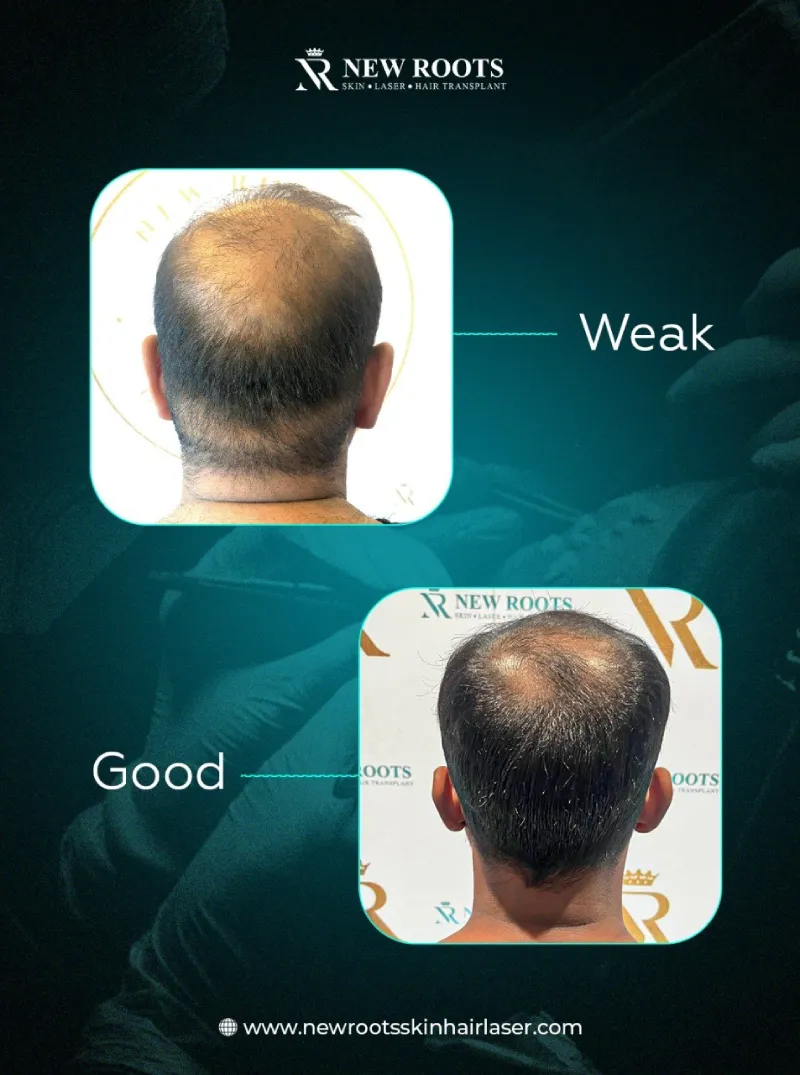
Patients who have strong donor area density tend to show a bit more flexibility, when they’re going for higher-density transplants. That said, donor hair really is a limited resource, so surgeons who are responsible have to juggle graft extraction carefully with long‑term donor preservation.
In other words, it’s not just about taking more, it’s also about not harming the future supply, and keeping the donor compatible for what comes later.
Hairline Density Design: Creating Natural Results
The hairline is one of the most visible parts of a hair transplant. Proper hairline density design is essential for achieving a natural appearance.
An effective hairline should:
- Match facial proportions
- Reflect the patient’s age
- Follow natural growth patterns
- Include gradual density transitions
Most surgeons tend to set a higher density up at the frontal hairline, and a slightly lower density just behind it, kind of mimics how hair naturally is sprouting. It helps sidestep that obviously artificial look, even if on paper everything is actually fine.
Then again, if the hairline design is off even a little, then a transplant that gets done correctly can still come across as unnatural.
Hair Transplant Coverage vs Density
Patients usually end up stuck between hair transplant coverage and density, you know, and it gets a bit confusing. Coverage is more about handling a larger patch, like treating wider ground rather than going deep.
Density, on the other hand, is more concerned with building thicker looking hair in a smaller area, kind of concentrating the look.
Because donor hair is limited, surgeons have to weigh these two aims carefully, and not just in a straight line, if that makes sense.
For example:
A patient with extensive baldness may choose:
- Wider coverage with moderate density
- Higher density in the frontal zone with less crown coverage
The best approach depends on personal goals, donor resources, and future hair loss risk.
What Is a High Density Hair Transplant?
A high density hair transplant is basically when they put more grafts per square centimeter than the normal kind of procedure, you know the standard one.
Possible advantages could include:
- Fuller appearance
- Greater cosmetic impact
- Improved framing of facial features
- Enhanced patient satisfaction
Typically, high-density procedures aim for 45–60 grafts/cm² or more.
However, achieving high density requires:
- Healthy donor reserves
- Advanced surgical techniques
- Proper blood supply management
- Experienced surgeons
Not every patient is some kind of perfect match for a high density transplantation, like you know it.
Dense Packing Hair Transplant: How It Works
A dense packing hair transplant is a technique where grafts are implanted really close together, so the density can be maxed out. In a way it’s more of a close knit strategy than a “spread out” approach. This approach is usually brought up and used in:
- Hairline restoration
- Frontal scalp enhancement
- Cosmetic refinement procedures
Advantages include:
- Fuller appearance after one session
- Better visual density
- Reduced need for future touch-ups
However, doing too much dense packing can, in a way, mess up blood flow and make the graft survival worse if it is handled in the wrong way. So, this method really needs real expertise, and careful planning, overall.
The Importance of Graft Placement Technique
Even with a large number of grafts, poor implantation can mess with results a lot, sometimes. In general, a good graft placement approach kind of takes into account the following, not only the quantity:
Direction of growth
- Direction of growth
- Hair angle
- Spacing between grafts
- Natural distribution patterns
Proper placement creates:
- Natural hair movement
- Better density perception
- Improved scalp coverage
Today hair restoration kind of depends a lot on careful implantation steps to get the highest density and also those visual aesthetics, you know, it matters.
Hair Transplant Thickness Results: More Than Just Density
Patients often focus on density but overlook another important factor: hair thickness.
Hair transplant thickness results depend on:
- Hair shaft diameter
- Number of hairs per graft
- Hair texture
- Hair color contrast
For example, someone with thick hair can wind up with great fullness even at lower densities, while another person with fine hair might need more grafts in order to reach a comparable visual result, yeah.
That’s why surgeons often look at a bunch of hair traits at once, not just density alone.
Realistic Density Expectations After a Hair Transplant
Before starting any treatment, it’s essential to get a grip on what realistic density levels look like. Most people can not reach that same density, they remember having as teenagers. Instead, the aim is more like forming a natural look that’s also cosmetically pleasing.
Nowadays, transplants usually focus on:
- Improving scalp coverage
- Restoring facial framing
- Enhancing confidence
- Creating the illusion of fullness
Many successful procedures manage about 40–60% of the initial density, yet still give results that feel very satisfying in practice. Patients who get what those constraints look like tend to be happier with the outcomes, overall, even if the numbers aren’t as high as they first hoped.
How to Increase Hair Density After Transplant
Many individuals ask how to increase hair density after transplant once their procedure is complete.
Several strategies may help optimize long-term results.
Follow Post-Operative Instructions
Proper aftercare supports healing and maximizes graft survival.
Maintain Scalp Health
A healthy scalp environment encourages stronger hair growth.
Protect Existing Hair
Preserving native hair helps maintain overall density and appearance.
Nutritional Support
Balanced nutrition provides essential nutrients for healthy hair growth.
Additional Sessions
Some patients choose a second procedure to further improve density after the initial transplant has matured.
Hair Transplant Density in Bangladesh
In Bangladesh, hair restoration clinics have been, like more and more, using modern FUE approaches and fairly advanced density planning strategies.
People today can find seasoned professionals who are able to map out a personal treatment plan, based on what the donor area can realistically offer, how the hair behaves, and what cosmetic outcome the patient actually expects.
When choosing a clinic, it is better to pay attention to surgeon competence, the way the care is planned, and proof from documented results—rather than only comparing graft counts, or getting stuck on promotional discounts.
Conclusion
Getting a grasp on hair transplant density is basically crucial if you’re thinking about hair restoration. Sure, graft counts do matter, but the whole density plan isn’t just about loading in as many follicles as you can, kinda like that’s the only goal.
There are several elements that steer the result, hair graft density per cm2 counts, natural hair density matters too, and donor area density isn’t just background noise.
Add in the way the hairline density is shaped or designed, plus the graft placement technique, and suddenly it’s less straightforward than it sounds. Whether someone wants standard restoration or is aiming for a high density hair transplant, the main objective should still be natural appearance, balanced coverage, and results that stay sustainable over time.
When patients keep density expectations realistic and they collaborate with a qualified surgeon, they can reach meaningful improvements in hair coverage, visual thickness, and honestly, confidence too.
Frequently Asked Questions (FAQs)
Most surgeons usually target around 30–50 grafts per cm², but it depends on the treatment zone, how thick the hair shaft is, the general hair texture, and what you’re trying to look like overall.
It varies a lot, mainly based on how big the bald area is. In practice, many people end up needing something like 1,500 to 4,000 grafts just to reach a solid, pleasing level of coverage.
It’s not always possible to fully recreate the exact original, native density. Still, today’s methods can deliver a result that looks very natural, almost like normal growth—especially when the hairline design and angle are handled well.
Dense packing is basically a placement approach where grafts are set very close together, sometimes going beyond typical density targets, so the specific areas look more filled in and visually lush.
Not necessarily. The “best” outcome is more of a balance between density, what the donor area can provide, the hair characteristics, and how naturally the grafts are positioned. If donor resources are limited, going overly high with density may not actually improve the final look.
Archives
- August 2026 (1)
- July 2026 (8)
- June 2026 (7)
- May 2026 (10)
- March 2023 (1)
- November 2022 (1)
- October 2022 (2)
- August 2022 (3)
- July 2022 (4)