


True Angle Hair Implantation in Bangladesh for Natural & High-Density Hair Growth
Table of Contents
OVERVIEW
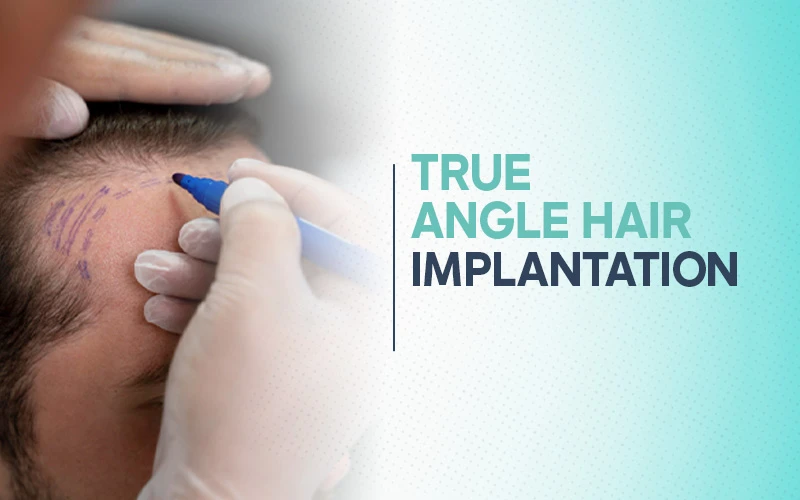
True Angle Hair Implantation is an advanced technique for the placement of grafts, which helps to improve the accuracy of hair transplantation. The technique involves placing each follicular unit at the desired angle, direction, and depth to ensure a natural-looking hairline and hair growth pattern.
The number of grafts transplanted is not the only factor that determines the success of a hair transplant; the placement of the grafts is also important. True Angle Hair Implantation focuses on the exact placement of the grafts to ensure natural-looking density and aesthetics, as well as overall transplant results.
WHAT IS TRUE ANGLE HAIR IMPLANTATION?
True Angle Hair Implantation is a specialized implantation technique in which the recipient site creation and placement of the grafts are done in a very controlled manner. The technique is designed to provide the patient with the most natural hair growth pattern possible by keeping the angle, direction and depth of the implant as planned as it is being inserted.
This approach can be used as part of modern hair transplant procedures to improve graft placement accuracy and optimize aesthetic results.
HOW DOES TRUE ANGLE HAIR IMPLANTATION WORK?
In traditional implantation techniques, the recipient sites are usually prepared prior to the implantation of the grafts. In the process, some changes in angle, direction or depth may be experienced.
True Angle Hair Implantation allows for better control of the placement of the grafts, which helps to ensure that the direction of each follicular unit is maintained during the implantation process.
The technique focuses on:
- Precise angle control
- Accurate directional placement
- Consistent implantation depth
- Gentle graft handling
- Natural hairline design
- Optimized density distribution
TECHNIQUE HIGHLIGHTS
This are evolved over the period of time. Before knowing these techniques, one should be familiar regarding following terms.
Accurate Angle & Direction Control
The angle and direction of the natural hair growth are planned for each graft, and then each graft is implanted accordingly. This helps produce a more natural look and helps seamlessly integrate transplanted hair with existing hair.
Looks natural and helps to seamlessly integrate transplanted hair with existing hair.
Controlled Implantation Depth
The implantation process is designed to ensure that the graft is placed at a constant depth. A uniform depth can help ensure the stability of the grafts and aesthetic uniformity.
Minimal Graft Handling
The technique minimizes unnecessary manipulation of grafts during implantation, helping maintain the integrity of delicate follicular units.
Reduced Graft Trauma
The purpose of the implantation process is to minimize unnecessary handling and friction when the graft is placed, thereby providing a good environment for its survival.
Higher Density Placement Potential
Precisely made implantation sites can enable the placement of grafts in closer proximity without compromising the angle and direction, which can help achieve a natural density.
Consistent and Uniform Results
Graft orientation is preserved during the entire process of implantation, which helps to ensure consistency in the treated area.
BENEFITS OF TRUE ANGLE HAIR IMPLANTATION
Natural Hair Growth Pattern
Hair is implanted in the direction and angle of the surrounding hair, which helps to create a realistic look.
Enhanced Hairline Design
A precise placement of the graft enables the creation of a very fine hairline, which matches the patient's facial characteristics.
Improved Density Distribution
Grafts are strategically placed to achieve even density throughout the grafted area.
Precision-Focused Technique
Each step of the implantation is done with care and precision, ensuring predictable and beautiful results.
Gentle Implantation Process
Minimizing graft manipulation helps maintain the integrity of the follicles during transplantation.
Personalized Treatment Approach
The implantation strategy is tailored to the patient's hair type, condition of the scalp, and desired outcomes for restoration.
WHO IS A GOOD CANDIDATE FOR TRUE ANGLE HAIR IMPLANTATION?
- Male pattern baldness
- Receding hairline
- Frontal hair loss
- Crown thinning
- Diffuse hair thinning
- Previous hair transplant correction cases
In a detailed consultation, it is determined if this type of implantation is suitable for the patient’s hair restoration needs.
WHAT IS THE SIGNIFICANCE OF IMPLANTATION ANGLE IN HAIR TRANSPLANTATION?
The angle at which grafts are placed is one of the most crucial factors that can impact the final look of a hair transplant.
Natural hair does not grow straight out from the scalp. The growth pattern and angle of different parts of the scalp are different. Even with high graft survival, hair may look unnatural if the grafts are not placed at the proper angle.
True Angle Hair Implantation is designed to achieve precise angle and direction control, aiming to mimic natural hair growth patterns and promote aesthetically pleasing results.
PERSONALIZED HAIRLINE DESIGN
Each person’s face, age, hair type and hair loss pattern is different. Before the procedure, a customized hairline design is created to ensure that the final result appears natural and age-appropriate. Facial balance and satisfaction with the outcome are achieved through proper planning.
WHY NEW ROOTS FOR TRUE ANGLE HAIR IMPLANTATION?
We use state-of-the-art hair restoration methods at New Roots and take the time to carefully plan each patient’s treatment to ensure they receive a natural look. We take care of every detail of the transplantation process, from the hairline design and the selection of the grafts to the exact placement of them and post-procedure care. We focus on precision, natural beauty, and personalized treatment plans to achieve outcomes that align with our patients’ distinct facial features and hair types.
FREQUENTLY ASKED QUESTIONS
The technique focuses on maintaining precise control over graft angle, direction, and depth during placement to support natural-looking results.
The suitability will be dependent on the amount of hair that can be donated, the severity of the hair loss, and the treatment objective. Assessment is a requirement for a consultation.
Scars may be more or less noticeable depending on the method of extraction and the person's healing process.
The length of the procedure can vary depending on the number of grafts being transplanted and the complexity of the treatment plan.
The time required for hair growth varies from person to person, and it usually takes a few months for results to be seen.
RELATED VIDEO

BEFORE & AFTER


